Keep Every Course Enrollment on Track
Map your curriculum proof and deadline workflow so instructors sign off before enrollment opens. Track each approval gate from syllabus review to course activation. Build a clear audit trail that satisfies registrar and accreditation requirements.
Three Ways to Generate curriculum workflow visual process maps
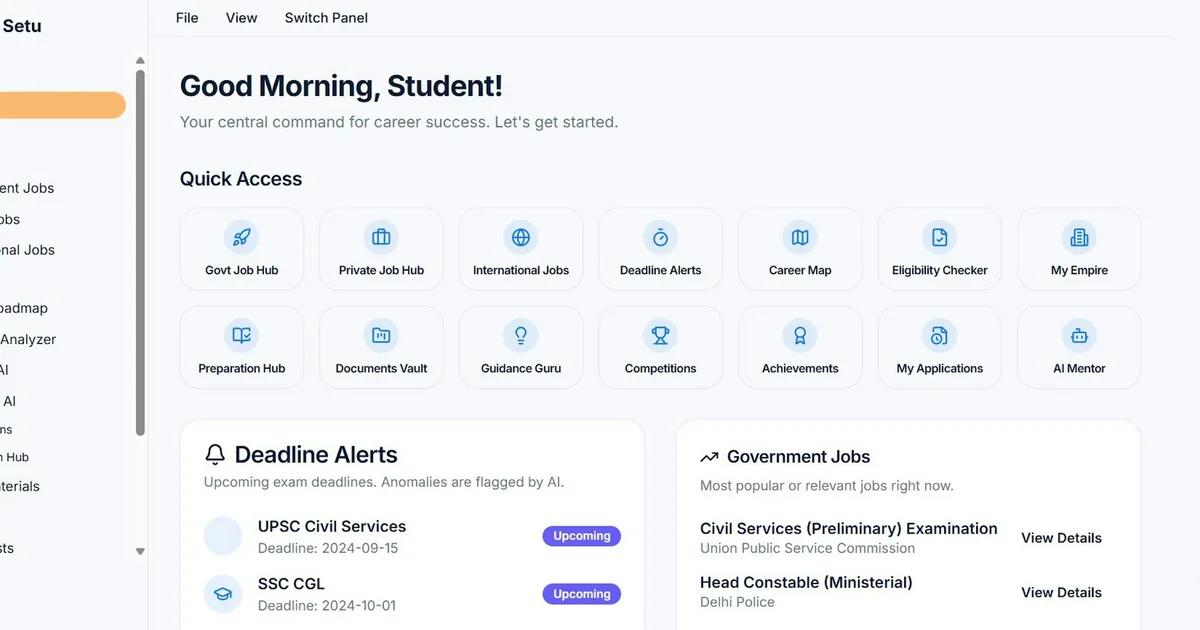
Describe Your Curriculum Approval Workflow and Generate the Visual Map
Type out your institution's approval stages — syllabus submission, learning outcome alignment, instructor sign-off, department review, registrar gate, enrollment activation — and an AI-assisted layout builds the visual structure around that content. This approach works well when your workflow is already defined but lives in a document no one wants to read. Veeso AI turns that text into a structured process map you can hand to any stakeholder.
- Paste your stage names and deadline dates to auto-populate a sequential flow chart
- AI-assisted layout arranges approval gates in a readable left-to-right or top-down sequence
- Each stage block is independently editable for gate conditions, owners, and trigger rules
- Export as a high-resolution PDF ready for curriculum committee review packets
Start From a Deadline Workflow Template and Customize Each Approval Gate
Pick a pre-structured enrollment deadline chart template that already shows a multi-stage approval sequence, then replace the placeholder stage names, dates, and owner labels with your institution's actual workflow. This saves time when you need a professional-looking document quickly and don't want to build the layout logic from scratch. Every element — colors, fonts, stage labels, and gate conditions — stays fully editable.
- Template library includes multi-stage approval flow layouts sized for print and screen
- Swap in your registrar submission deadlines, department names, and sign-off roles
- Adjust the number of approval stages without breaking the overall layout structure
- Duplicate the chart to create term-specific versions for fall, spring, and summer cycles
Import Your Existing Curriculum Documentation and Transform It Into a Structured Diagram
If your curriculum proof and deadline information already lives in a Word document, PDF, or Markdown file, you don't need to re-enter it manually. Import the file and the tool structures the content into visual pages, turning dense policy text into a scannable workflow diagram. This method is especially useful for converting registrar deadline guides or curriculum change approval process documents into visuals that non-specialist staff can actually follow.
- Import PDF, Word, or Markdown files containing existing curriculum workflow documentation
- Content is parsed into structured visual stages, not dropped in as a flat text block
- Edit any imported stage, deadline, or gate condition directly in the output layout
- Produce a coordinated set of diagrams — one per department or one per term — from the same source file
Why choose Veeso for your editable enrollment deadline chart sets
Keep Registrar Submission Deadlines Visible Across Every Stage
Curriculum teams often track approval deadlines in scattered emails and spreadsheets, which means a missed registrar submission window can delay course activation by an entire term. A visual deadline chart puts every gate — from syllabus draft to enrollment window open — on one readable page. When everyone sees the same timeline, handoffs happen on time and courses go live as planned.
Try It Free
Show the Proof-to-Enrollment Sequence Without Ambiguity
Department chairs, instructors, and registrar staff each see only their slice of the curriculum approval workflow, which creates gaps where proposals stall. A structured visual map shows who owns each stage, what triggers the next handoff, and what a blocked gate looks like. That shared picture reduces back-and-forth and keeps the sequence moving forward.
Try It Free
Update Enrollment Gate Conditions Without Rebuilding From Scratch
Prerequisite rules and approval gate conditions change every catalog cycle, and a static PDF becomes outdated the moment policy shifts. Editable chart sets let curriculum coordinators swap out dates, add new review stages, or adjust gate logic without redesigning the whole document. Tools like Veeso AI output fully editable layouts, so every text box and stage label stays adjustable as requirements evolve.
Try It Free
Produce Print-Ready Documentation for Curriculum Committee Review
Curriculum committee review meetings require clear, professional documentation that committee members can read quickly and annotate. A well-formatted deadline workflow chart communicates the approval sequence faster than a dense written report. High-resolution export means the same file works in a projected slide deck, a printed packet, or a shared PDF without quality loss.
Try It Free
Who Uses Curriculum Proof Deadline Workflow Diagrams and Enrollment Approval Charts?
Community College Registrar Managing Multi-Department Catalog Deadlines
A registrar coordinating twenty or more course sections across departments faces a recurring problem: instructors submit curriculum proofs at different times, and it's easy to lose track of which sections are cleared for enrollment and which are still waiting on a department chair sign-off. Setting up a structured course enrollment curriculum proof deadline workflow gives each course its own approval gate. The registrar can see at a glance which sections have verified learning outcomes, which are pending instructor review, and which have missed their catalog submission window before the student registration period opens.
Corporate L&D Team Running Approval-Based Enrollment for Compliance Training
A learning and development team rolling out mandatory compliance courses can't afford to let employees enroll before the curriculum has been reviewed and signed off. An approval-based course enrollment system ties enrollment activation directly to the completion of upstream review steps. Once a training manager confirms that learning outcomes align with regulatory requirements and an instructor has submitted their final proof, the enrollment gate opens automatically. This creates a documented audit trail that proves curriculum was approved before any employee accessed the course, which matters when an external auditor asks for evidence.
University Curriculum Committee Sequencing Prerequisite Verification Before Course Preview
Before a new elective appears in the course catalog and prospective students can preview it, the curriculum committee needs to confirm that prerequisite verification is complete and learning outcome alignment has been signed off. Without a clear sequence, course previews sometimes go live before the syllabus proof approval is finished, which creates confusion and forces corrections mid-registration window. Building a workflow that locks the course preview step behind instructor sign-off and committee review prevents that problem and keeps the course catalog publishing process clean and defensible.
Instructional Designer Tracking Concurrent Course Approvals Across a Program Launch
An instructional designer launching a multi-course certificate program needs to manage several curriculum approval workflows running at the same time. Each course has its own academic deadline triggers, its own instructor, and its own review stage. A shared workflow board that maps each course section to its current proof status makes it possible to spot bottlenecks early. When one course is stuck at the learning outcomes review stage while others are already cleared for enrollment, the designer can follow up with the right person instead of sending blanket reminders that everyone ignores.
Online Course Platform Operator Automating Enrollment and Unenrollment Based on Approval Status
A platform operator managing a catalog of instructor-led courses needs enrollment to activate only after curriculum content passes a defined review. Automated enrollment and unenrollment workflow rules tied to approval status changes remove the manual step of checking each course individually. When an instructor submits a final proof and a reviewer marks it approved, the enrollment window opens. If an approval is revoked or a course is flagged for revision, the unenrollment rule fires and the section is pulled from the active catalog until the issue is resolved. Veeso AI can help the team design clear visual status dashboards and communication materials that explain the workflow to instructors and department contacts.
Accreditation Coordinator Building a Compliance Documentation Trail for Program Review
When an accreditation review is approaching, a coordinator needs to show that every course in the program followed a documented proof-to-enrollment pipeline. Scattered emails and informal approvals don't hold up under scrutiny. A structured curriculum change approval process that captures each step, from initial submission through learning outcome alignment checks to final instructor sign-off, produces the compliance documentation trail reviewers expect. Veeso AI can support this process by helping the team create clear, editable visual summaries of the workflow that can be included in accreditation submission packets alongside the underlying records.
Why registrar staff, instructional designers, and department chairs Choose Veeso AI
How to Create High-Converting curriculum proof approval workflow diagrams
Map Out Every Approval Stage Before You Touch the Layout
Write down each stage in your curriculum proof-to-enrollment sequence — syllabus draft, learning outcome alignment check, instructor sign-off, department chair review, registrar deadline gate, and enrollment window activation. Knowing the full sequence before you start designing prevents you from building a chart that leaves out a critical handoff.
Assign Deadline Triggers and Gate Conditions to Each Stage
For each stage, note what triggers the handoff forward and what blocks it — for example, enrollment cannot open until the registrar confirms syllabus proof approval. Adding this logic to your diagram turns a simple flowchart into a working reference that staff can use to catch stalled proposals before they miss a catalog deadline.
Build the Visual Workflow Diagram With Your Content as the Starting Point
Paste your stage list, deadline dates, and gate conditions into your design tool, or import the document where that information already lives. Veeso AI arranges the content into a structured, editable process map so you can adjust stage order, owner labels, and deadline fields without rebuilding the layout from scratch.
Export and Distribute the Diagram to Every Stakeholder in the Sequence
Export the finished curriculum proof approval workflow diagram as a high-resolution PDF or PNG, then share it with instructors, department chairs, and registrar staff through your normal distribution channels. A single shared visual reference reduces the back-and-forth that happens when each group is working from a different version of the deadline schedule.
FAQ

Ready to Create Beautiful Editable Enrollment Deadline Chart Sets with Veeso AI?
Start Creating NowNo credit card required • Free to start • No design skills required
Explore More AI Graphic Design Use Cases
Discover more creative design scenarios powered by Veeso AI.